
Why bleach fails — and what actually removes mould.
Most mould cleaning on the Sunshine Coast is a bottle of chlorine and a cloth. Here’s why that keeps failing
— and what removing mould properly actually involves.
The problem with bleach
Mould isn’t just the dark patch you can see. It anchors itself with root-like structures that grow down into any porous material, including plasterboard, timber, carpet and paint. Chlorine bleach has a strong surface action: it strips the colour from the visible mould, but it doesn’t reach those roots — so the material stays colonised. The patch looks clean, and a few weeks later it’s back, often bigger.
Mould roots in a porous surface
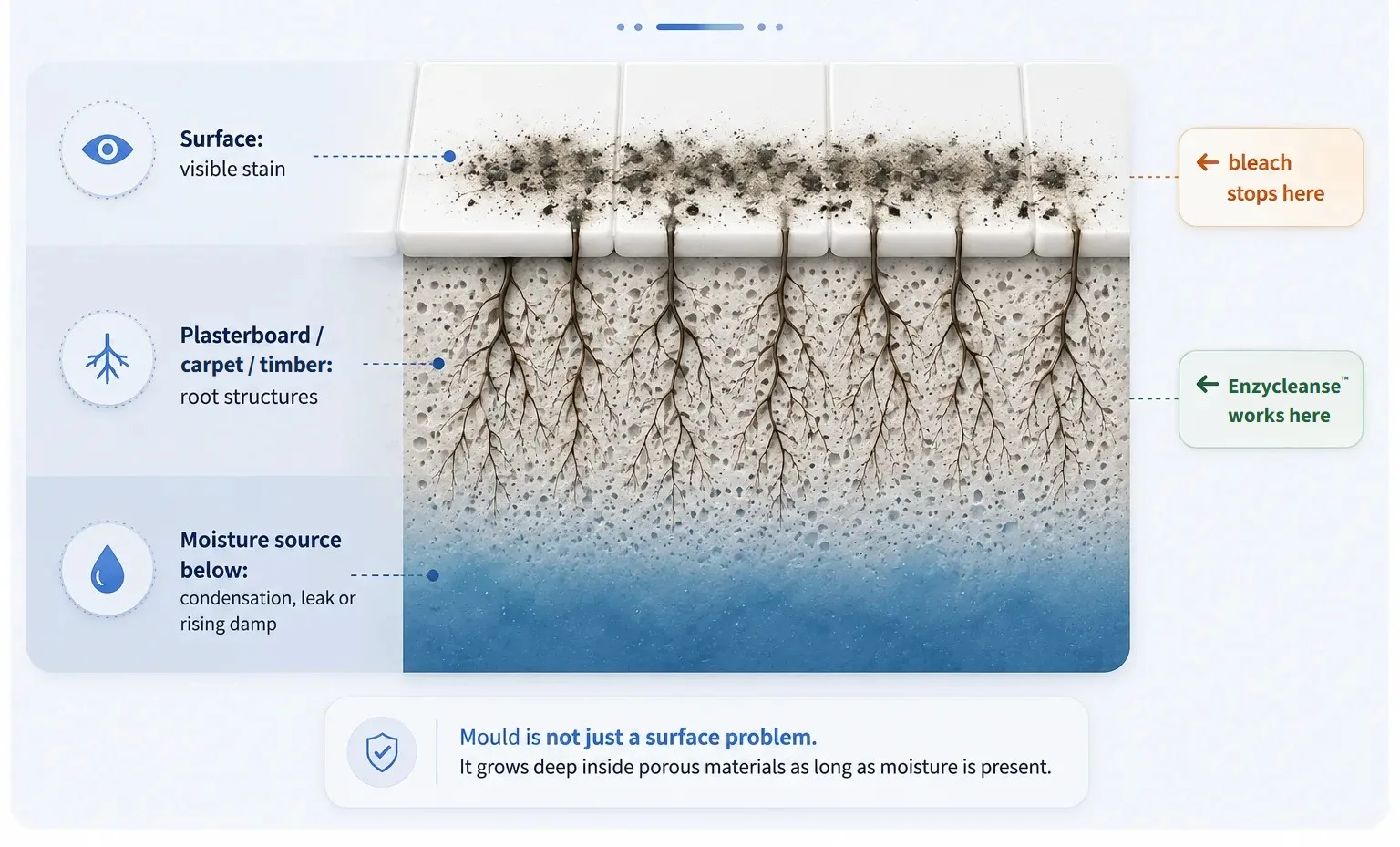
How our enzyme treatment is different
We use a plant-based enzyme solution applied as a fine dry fog. The fog penetrates porous surfaces and the enzymes break down mould structures at the source — the roots, not just the stain. Because it is applied as a dry fog it reaches ceiling corners, wardrobe backs, soft furnishings and the places a cloth never touches. It is non-toxic and plant-derived, so it is a treatment you can be comfortable having in a family home.
Then we prove it
Before-and-after air sampling is analysed by Independent Environmental & Consulting Laboratories (IECL) in Brisbane — an independent third party with no stake in the result. You get spore counts, conclusions and recommendations in writing: numbers, not adjectives.
Why we ask for one night — and quick services don’t
Some companies will have you back inside within two or three hours. That’s possible when the treatment is a surface wipe and a light mist. Our Enzycleanse™ dry fog needs 24 hours to fully penetrate porous materials and settle — because it’s working inside the plasterboard, carpets and the timber, not just on top of the surface.
Mould doesn’t have a mould problem. It has a water problem.
Spores are in the air of every home on the coast, all year round. They’re harmless until they find moisture — which is why the real question at an assessment is never “is there mould”, it’s “where is the water coming from”. In this climate it’s nearly always one of three sources:
Condensation & still air
Warm humid air hitting a cool surface: bathrooms without extraction, wardrobes on external walls, windows that weep every morning.
Leaks & water ingress
A failed shower seal, a lifted roof tile, perished flashing, a blocked gutter. Usually invisible until the mould shows you where it is.
Rising damp & subfloor moisture
Ground water wicking up through slabs, brickwork and timber — worst on shaded blocks and where drainage falls the wrong way.
Your free assessment includes moisture readings, so you’ll know which one you’re dealing with — and what fixing it properly involves — before you spend anything.
Built by a builder
Mould has a cause — and identifying it is only half the job. With 30+ years in the construction industry, we don’t just treat the symptoms; we can repair the leak, improve the ventilation or fix the drainage that caused it. That’s the part most mould companies can’t offer.